Showing posts with label drawing. Show all posts

Monday, January 20, 2020

Daily Painting: Frequent Practice is Essential for Mastery

Don't let anything get in the way of your daily art practice!
As a born perfectionist and over thinker, I am not really a huge "doer" when compared to some people. Despite being a quick start, I tend to avoid finishing projects in favour of a shiny new project or idea. Also, my preferred method is to mull things over until I feel like I have everything figured out in order to to avoid nasty mistakes. 

Malcolm Gladwell talked about the need for 10,000 hours of practice to master anything. Some disagree with that number and I would say that it is important to have a lot of focused practice, not just putting in the hours. That may involve taking classes, reading books, watching demos and working on specific tasks to improve where you are weak. Plein air outdoor painting, for instance is a great challenge to take on that will help you quickly nail values and colour in your work. Working from life in the studio is a valuable practice as well, for many of the same reasons, but a little easier since you can control your lighting.

If you want a scientific study to prove the conjecture that producing more work is better than trying to just complete one masterpiece, this quote from the book, Art and Fear, is enlightening:
The ceramics teacher announced on opening day that he was dividing the class into two groups. All those on the left side of the studio, he said, would be graded solely on the quantity of work they produced, all those on the right solely on its quality. His procedure was simple: on the final day of class he would bring in his bathroom scales and weigh the work of the "quantity" group: fifty pound of pots rated an "A", forty pounds a "B", and so on. Those being graded on "quality", however, needed to produce only one pot - albeit a perfect one - to get an "A".

Well, came grading time and a curious fact emerged: the works of highest quality were all produced by the group being graded for quantity. It seems that while the "quantity" group was busily churning out piles of work - and learning from their mistakes - the "quality" group had sat theorizing about perfection, and in the end had little more to show for their efforts than grandiose theories and a pile of dead clay.
The more paintings you have done, the more experience you have gained and as you progress you will find that quality springs from quantity. The more often you create, the better you become at your chosen vocation. Fortunately, over time I have managed to put in a lot of hours and a lot of study, despite myself and can now see the value in having a consistent, regular art practice with focused attention to areas that need work. 

Creating art on a daily basis can be a real life challenge for many of us, whether it is kids, a necessary job that pays the bills, health problems that cause endless appointments or family responsibilities that get in the way. Many of these are an ongoing struggle for me, so I empathize with others who may have even more challenging circumstances. So, how can we possibly have a daily art practice?

One of the best ways to improve quickly and feel more comfortable is to work small - in this way you can incorporate all the elements of a bigger painting - composition, colour, value, texture, big shapes and, most importantly, confidence! Then you can go on to apply the lessons learned to larger pieces.

All this is not to say that there is no value in "book learning" or studying the work of master painters, but there is no substitute for the daily grind of going to your room (as the late Robert Genn recommended) and doing your work.

* photo obviously not mine - can't find the origin to credit, so if anyone knows, please let me know!

Wednesday, May 24, 2017

The Daily Painting Habit: Day 21 of 21 - Charcoal Portrait Sketch #2

Connor
This will be charcoal portrait sketch #2 for 2017 and officially the end of my 21-day challenge (mostly painting and some drawing) that took WAY longer.

I am astonished that artists consistently do these 30-day challenges every six months (usually led by Leslie Saeta) and keep up! It is just not in my DNA to pronounce anything finished until I am happy with it and that often takes some time. I am okay with that.

That doesn't mean I will stop doing these small paintings and sketches. I strongly believe that creating on a daily basis is great for artistic growth, so my plan is to be in the studio on a daily basis, whether that is to create a small sketch or painting or working on larger pieces.

This drawing was a challenge due to most of the face being in shadow.

You always have to subdue everything in the shadows no matter how bright it seems when you look at that area, so I darkened the white of his eye in shadow more than I initially thought it should be. Black in light is lighter than white in shadow. There is a definite distinction between light and shadow and values do are not shared on either side!

When I was doing this, I thought of Sargent's charcoal portrait drawings that I have had the pleasure of viewing. A lot of them have a dark mass behind the light side of the face. I think it lends some drama.

In retrospect, I think I should have done this on toned paper with white chalk highlights - hey, maybe I will still do that!

Thursday, May 18, 2017

The Daily Painting Habit: Day 20 of 21 - Charcoal Portrait Sketch


Austin with Shouldice
So, I am back, finally. Despite my lack of posting, I have been producing some work, including a lot of preparatory stuff for some large pieces I am planning.

Over the past few months, life has gotten in the way of art a bit. I have been dealing with a few ongoing health challenges that have prevented me from doing as much as I would have liked. I might write more about that at another time, or maybe not - we are all dealing with one thing or another and I don't want to be a bore.

For now, here is my latest work of art, a charcoal sketch. Charcoal is a rather messy medium and not for those who want a lot of control but it is also fun and easy to manipulate for a painterly, massed in type of drawing.

Thursday, May 01, 2014

Portrait Society of America "The Art of the Portrait" 2014 Conference - April 24

Watching the proceedings

After a short flight from Toronto Island Airport via Porter Air, and a quick shuttle ride to our event hotel,  I immediately had the pleasure of observing simultaneous demos from a number of skilled portrait artists. This event, called the "Face-Off" marked the beginning of the exciting annual event, The Art of the Portrait: National Portrait and Figurative Artist's Conference. There were five models from which 15 artists created 2 1/2 hour sketches, which were later auctioned off to benefit The Portrait Society of America's charitable endeavours.


Painting by Jeffrey Hein


Drawing by Daniel Sprick
Painting by Ellen Cooper

Painting by Scott Burdick

View of Reston Town Centre - Location of 2014 "The Art of The Portrait" Conference

*Photos by Connor McBrine-Ellis - Hyperact Media

Saturday, August 21, 2010

Preparatory Sketch


There was a lot of glare so my teenage subject is squinting a little, even though he is sitting in the shade.

Wednesday, January 06, 2010

Initial Sketch for painting of Donovan Bailey at the Spoke Club


Here is the full size sketch of Donovan Bailey, done on a couple of large sheets of 24x36 newsprint taped together.

Making a sketch allows me to get the drawing right and then move the piece of paper (to position of the figure) around the canvas to see what works best for my composition.

Since I have to work from photographic reference material for this piece, I don't have the luxury of life sittings and the freedom to just start painting with my subject right there in front of me, full size, to compare. Therefore, the information I have in a small photograph on my computer screen must be blown up to a life size image.

An easy way to transfer a large sketch like this to the painting support is to oil the surface slightly, brush on paint mixed with a little medium, lay the drawing on top and draw over your lines. Afterward, I use a rag to wipe out the lights and add some details in darker paint and to produce a massed block in of the composition.

It is important to keep in mind that this is a general guide for placement and I do not try to stay within the lines when painting!

Once the monochrome painting is dry, it is easy to maintain the planned notan (value pattern) and not go off track from the initial idea.

Sunday, October 01, 2006

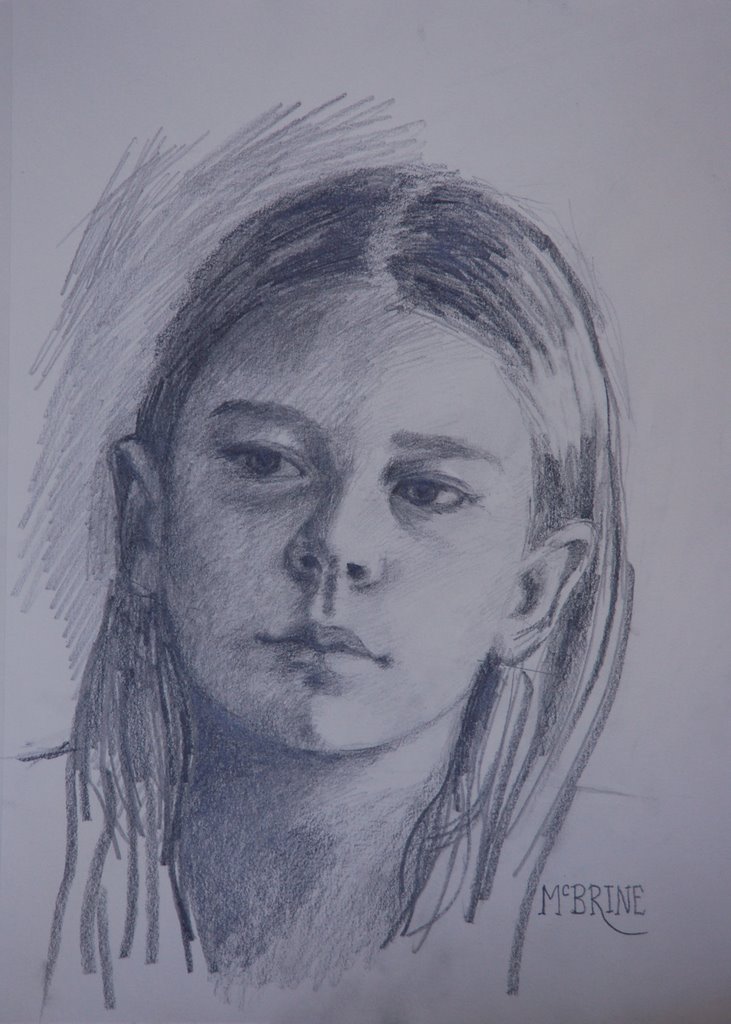
Fiona

Sketch of a lovely nine year old girl.