Showing posts with label Everett Raymond Kinstler. Show all posts

Tuesday, May 19, 2015

Final Day of Portrait Society of America 2015 Conference

Sunday morning there was a symposium by a group of eminent artists, followed by two drawing demos by Burton Silverman. It is always interesting to hear successful artists talk about their journey and offer pearls of wisdom.
Sculptor Rhoda Sherbell with Daniel Greene


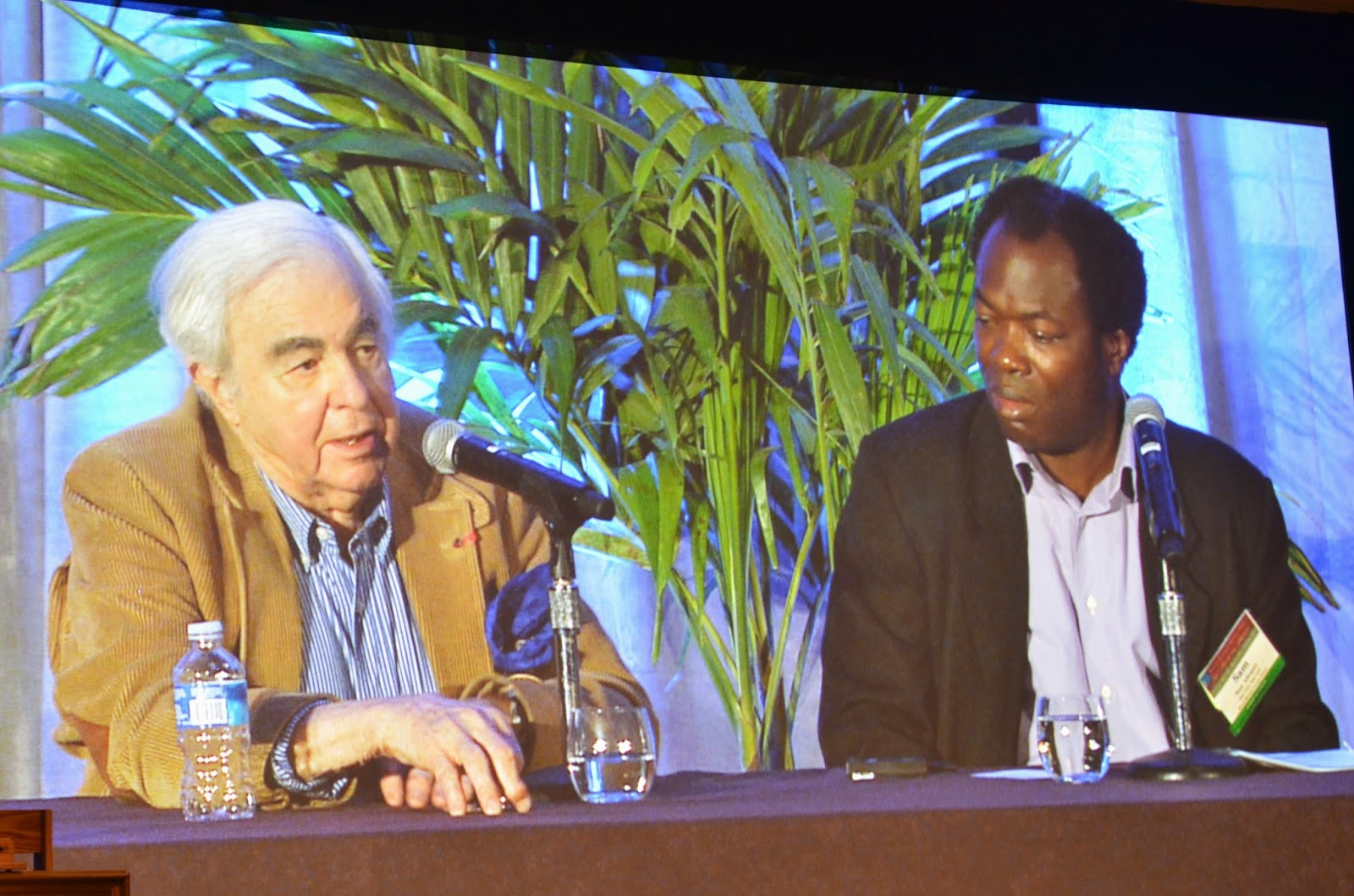
Everett Raymond Kinstler and artist/author Samuel Adoquei

Mr. Adoquei talked about inspiration. He has a couple of wonderful books available, including The Origin of Inspiration which applies to any creative field. If you do not have Mr. Adoquei's books, make sure to add them to your library!

Mr. Greene showed a number of his series of art auction paintings and shared how he created them. He also offered a great tip about storing leftover paint - he said to be careful with freezing paint, since bloom can occur due to moisture that remains on the surface of the paints.

Mr. Kinstler talked about how painting is a means to communicate and how important it is to have passion and imagination. He recommended that we should assess our paintings by asking how much we can remove that is not contributing to what we are trying to say.

I did not get a photo of the wonderful work shown by the other artists, but here are a couple of the newer works by Mr. Kinstler. 
Painting by Everett Raymond Kinstler
Drawing by Everett Raymond Kinstler
The final presentation was by master artist Burton Silverman, who created two drawings while talking about, "finding your own voice". He said that mistakes are very helpful. Making corrections helps you find out if you have really gotten to the heart of what you want to say. If you make a correction, you need to see what that does to the other decisions you have made. Change allows for imaginative speculation and lets air in.

When speaking of sincerity in art, he said that, "children are rotten", (which got a huge laugh from the audience) and so perhaps the angelic, dressed in white, image that is often seen may not be the only choice.

Mr. Silverman also spoke about how we can learn, even steal, from each other in that we can employ similar techniques. Community is important.

Burton Silverman
Burton Silverman's grandchild in his sketchbook
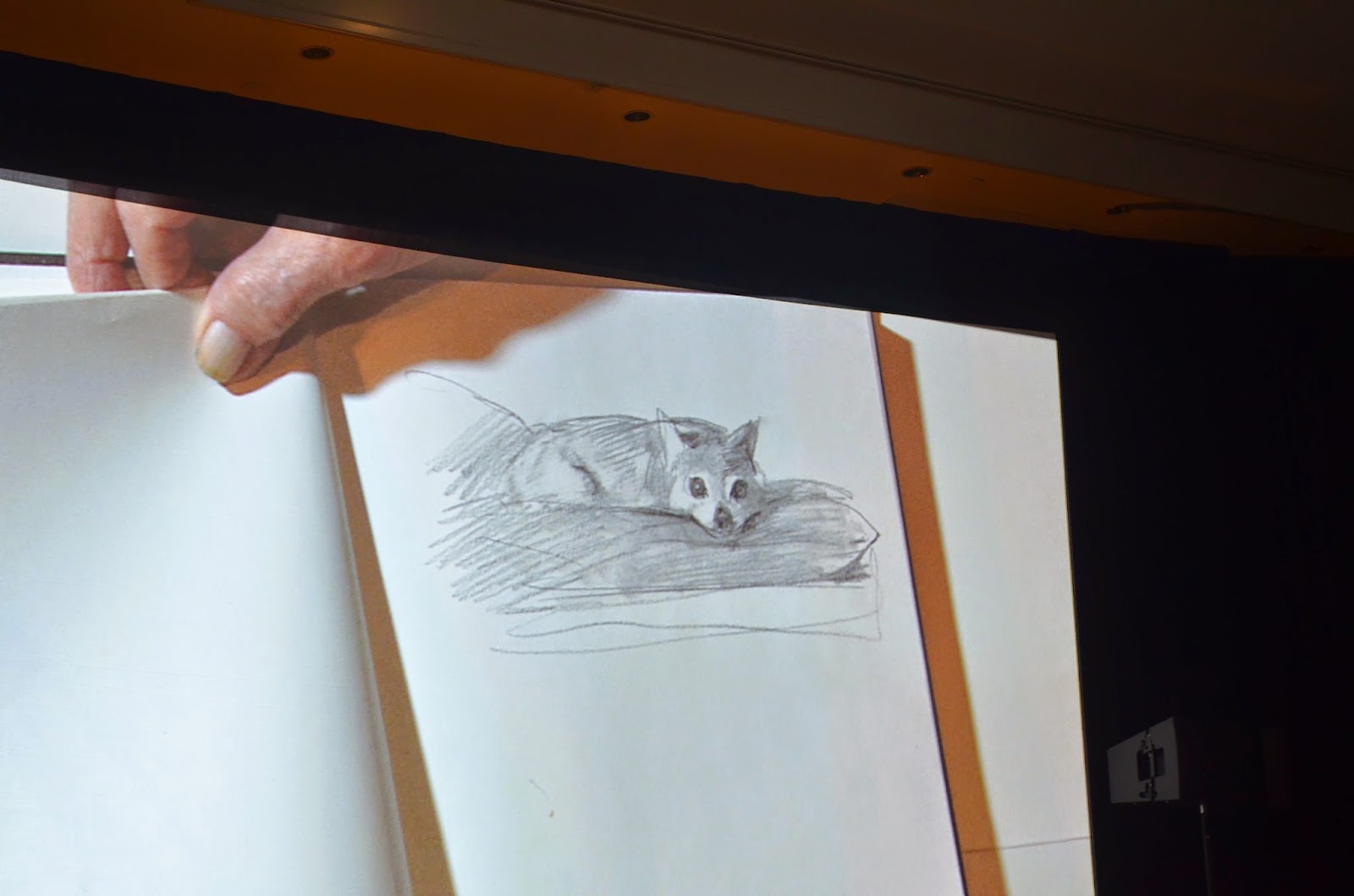
Delightful drawing from Burton Silverman's sketchbook

For the first drawing he employed a soft graphite pencil in a holder, a stomp and a kneaded eraser. Practical tips included using a pencil holder to use those pencil stubs you may have lying about tour studio. 

He mentioned that General's HB is harder than his preference and seems to be holding a bit of a grudge after mentioning a bad experience with customer service many years ago, which I found rather amusing. He complained about something being wrong with some pencils and didn't get a reply. Note to art material manufacturers - don't tick off a master artist!
Drawing #1 by Burton Silverman

For the second drawing, Mr. Silverman used a Wolfe's carbon pencil, that is a little harder than General's, so more controllable, with more subtle definitions. He also employed a little color in the cheeks for the second drawing. 
Drawing #2 by Burton Silverman


Wednesday, May 06, 2015

Everett Raymond Kinstler and Richard Ormond Chat About Sargent - and a FREE BOOK!

First thing on May 1, 2015 (Friday morning) we had the pleasure of witnessing the first meeting between Mr. Kinstler and Mr. Ormond (who is the grandson of Violet, Sargent's youngest sister). The two men are both passionately obsessed with John Singer Sargent, so the conversation was never dull.

The banter between the two gentlemen was delightful. I loved it when they politely contradicted each other over dates - I believe Mr. Ormond joked, "I won't quibble, but ... " about some small detail or other.  I love the expressions used by the British! I think at one point Mr. Ormond referred to himself (as a child) as, "quite a naughty boy" (which I thought was rather funny) and that, as such, he found his grandmother Violet rather fearsome and formidable.

A little known fact about Sargent include that he served as a consultant to museums with regard to buying Old Master's art. He was, along with Henry James, one of two great recorders of the golden age. He said that every portrait should have an element of caricature. He created at least 600 charcoal drawings, which Mr. Ormond is now trying to track down in order to catalogue them for posterity. For a really obscure fact, he sometimes traveled with a stuffed deer!

A few books recommended by Mr. Ormond (in addition to all the amazing, huge volumes produced by Mr. Ormond himself) included those by Evan Charteris (download this one, entitled John Sargent, for FREE here - you are welcome!), John Singer Sargent: A Conversation Piece by Martin Birnbaum (**see excerpt from the book at the end of this post below) and a third book, entitled, Sargent at Broadway: The Impressionist Years, which was co-written by Stanley Olson, Warren Adelson and Mr. Ormond.

Dawn Whitelaw introduced the two distinguished gentlemen 
Sargent's sister, Emily, was a gifted watercolorist in her own right yet did not exhibit her work. She was modest yet ascerbic, opinionated and intelligent. Emily served as hostess for Sargent, who remained unmarried his entire life.

Sargent was offered both a knighthood and membership in The Royal Academy. He refused both, as at least one of those honors would have entailed giving up his American citizenship.


Mr. Ormond mentioned that Sargent was not malingering, like the rest of his family, who always seemed to be ill with some malady or other. He had the robust strength to travel and participate fully in life. Despite being out and about, with lots of friends, he was apparently a bit of a social disaster. If you were unlucky enough to be seated next to him at dinner, you would have had your work cut out to engage him in much conversation.

Sargent could paint anywhere and anything and find a way to make it interesting. He was a decent man, comfortable with himself and always looking forward. He was cultured, intelligent, private, reserved and diffident. His keen observation resulted in paintings too gorgeous for his own good - he made very difficult paintings look easy.

One thing is for sure - we know where Richard Ormond got his eyebrows! He bears a striking resemblance to John Singer Sargent's father, Mr. Fitzwilliam Sargent.

**Excerpt from A Conversation Piece by Martin Birnbaum:
    “Sargent never surrounded himself with an aura, and violently disliked a note of flattery which he could instantly detect.  DeGlehn’s story of a visit to Sargent with Claude Monet bears this out.  It seems that the two guests remained all day, lunching and dining with Sargent.  Naturally they spent part of their time in their host’s studio, filled at the time with some of the sensational Wertheimer portraits.  DeGlehn was amazed that Monet hardly looked at them and he not only resented the Frenchman’s attitude but mentioned the matter to Sargent.  “But he hates this sort of painting” declared Sargent, to whom, however, Monet ever remained a great friend. Indeed, Sargent himself enjoyed poking fun even at his best works.  “The Idiots of the Mountain” was the way he referred to the exquisite picture known as “The Cashmere Shawl”, all posed for by his beloved niece Rose-Marie Ormond Michel who perished in Paris when the Germans bombed the church of St. Gervais.” 
    (Excerpt from “John Singer Sargent, A Conversation Piece” By Martin Birnbaum,  New York, Wm E. Rudge’s Sons, 1941, 80pp pp40-41  )
I found this quote HERE.

Sunday, May 04, 2014

Portrait Society of America "The Art of the Portrait" 2014 Conference - April 27 highlights


Demo by Robert Liberace and Rose Frantzen on big screen
The final day of the conference, there was a panel discussion with a number of distinguished painters, including Wende Caporale (who acted as moderator), Daniel Greene, Burton Silverman, Everett Raymond Kinstler, Rhoda Sherbell and Mary Whyte.


I especially enjoyed Daniel Greene's account of dealing with clients and Wende's comment that she had never heard him speak so much (after she, unfortunately, had to cut him off in order to get to the next speaker). It was also a lot of fun to hear Mr. Kinstler talk about his experience working with Katharine Hepburn (hint: she drove him crazy!) and how things worked out in the end!

I love the stance Rose takes when painting, very assertive!

The final demo was by Rose Frantzen and Robert Liberace, both amazing painters. James Gurney was also busy to the right of the stage, capturing the artists as they worked!

A few painting notes:
  • Rose said that she wants to try all the ways to back the cake so is open to many ways of painting.
  • Robert used the handle of his brush to scratch out details like the eyebrow hairs, which I thought was a nifty trick.


The Start


On a final note, the conference next year is going to be in Atlanta from April 30 - May 3, 2015! I would strongly encourage any figurative or portrait artists out there to make plans to attend and get inspired!

James Gurney
Model checking himself out

Rose's materials
James Gurney capturing the action
The materials of James Gurney set up at the edge of the stage.
You can see the flyer for Rose's book also.


Oil Painting by Rose Frantzen
near completion (detail)

Saturday, May 03, 2014

Portrait Society of America "The Art of the Portrait" 2014 Conference - April 26 highlights

The Legendary Mr. Everett Raymond Kinstler
One of the highlights of the conference was when Everett Raymond Kinstler spoke and gave some enlightening critiques of a selection of paintings. Mr. Kinstler (even though he says to call him Ray, I have trouble doing that, I have so much respect for the great man!) is a really great artist, true gentleman and so popular, there is always a line-up to speak to him but I finally managed to get a chance to say hi and renew our acquaintance. He is still (at age 88) as passionate as ever about painting and he can't wait to get up every morning and get to work! His talk on Saturday emphasized the need to paint what you care about. He always keeps his eyes on the past and draws constantly in his sketchbook, in addition to his painting projects.

Some notes from his talk:
  • There are no shortcuts, but there is nothing better than making a living doing something you are passionate about. 
  • Keep learning and being stimulated. 
  • Keep in mind the essential character and not the accidental appearance. 
  • Go beyond the photo into what you want it to be. 
  • Don't render everything.
  • Get the feeling and take out anything that does not contribute.
Mr. Kinstler had an interesting story about juried shows that should be a lesson to artists everywhere. He said we should not get too excited about awards and honours but on the other hand we should not become depressed or dejected over rejection either. He told of being rejected twice from a watercolor show and could not figure out why the painting had been refused. He entered the exact same painting to the exact same organization a third time and ended up winning the top prize!  So, his advice is to never take anything too seriously, just get on with your work!

I also attended a very early morning session of The Cecilia Beaux Forum. Chris Saper, Judy Takacs, Kate Stone and (the sole guy) David Gluck spoke about self-publishing, social media and blogging. I wish I could have attended all three of the sessions that ran concurrently!

Saturday's program also included a demo by watercolourist Mary Whyte and an oil demo by Daniel Greene.


Mary Whyte and her favorite model answering questions from the audience

Daniel Greene recommended using a mirror to check for grievous errors in drawing. When starting to paint, he goes from dark to light, with darks a little lighter (and thinner) and lights a little darker (and more opaque) than they actually are. This leaves a little room to progressively alter things. After massing in the shadow pattern, he scribbles on colour in the light areas of skin.
Daniel Greene's precise start to portrait of Jack Richeson
I didn't attend the evening banquet, but Facebook soon announced the William Draper Grand Prize Winner - Bryce Billings, who accepted the award with his son (who is also in the painting). I was not surprised to hear that he had won the prize, as his painting was not only beautiful and technically well done, it had emotional impact and the guy even made his own, very unique wooden frame! Those piles of paint on the palette were also really 3-D, which I loved.

I also really liked the figurative work by Olga Krimon, which depicted a young woman reclining beside a table. It was colourful, had great composition plus brushwork and is a painting I would love to hang on my wall!

More highlights tomorrow - don't miss the final day! 

A Father's Dreams and A Son's Love (detail)
photo by Connor McBrine-Ellis - Hyperact Media

Wednesday, February 21, 2007

Geneen - Oil Sketch from Life


This past weekend, I had the privilege of studying with the wonderful painter, Mr. Everett Raymond Kinstler at The Art Students League in New York City. Mr. Kinstler is one of the foremost portrait painters in the United States and has painted numerous celebrities, politicians and presidents. He is also a really nice guy and gives constructive criticism to help other painters improve their work.

Everett Raymond Kinstler


Mr. Kinstler's palette - some of the colors were:
 
Burnt Umber, Sap Green, Ultramarine Blue, Cerulean Blue, Alizarin Crimson, Cadmium Red Light, Raw Sienna, Cadmium Yellow Light, Titanium White

He also uses Burnt Sienna and Black.